
There are two important distinctions when it comes to AI companies. The first pertains to their status as for-profit or non-profit entities. The second is the specific legal vehicle under which they operate.
1. For-Profit / Non-Profit Status
For-profit and non-profit entities operate under different legal frameworks. For-profit entities prioritize generating revenue for their owners. Non-profit entities pursue broader public interest, in return for which they receive significant tax advantages.8The variations of fiscal treatment among these various legal vehicles are beyond the scope of this report.They are often called 501(c)(3)s, a shorthand for the relevant federal tax code provision exemption. Non-profits must act consistently with their charitable purpose and use their assets in pursuance of their mission. The last section lays out in greater detail the protection of the charitable purpose and assets of non-profit organizations.
→ Most AI companies operate as for-profit entities, with the notable exception of OpenAI, which was conceived as a tax-exempt non-profit charitable organization.
2. Legal Vehicle
AI companies have to choose a specific legal vehicle to carry out their activities. Corporations, limited liability companies (LLCs) and limited partnerships (LPs) involve different goals and rules in terms of control, ownership, transparency and liability.9Since Delaware is the jurisdiction of choice for incorporation for most U.S. businesses, including AI companies, the descriptions below reflect Delaware rules unless noted otherwise. (<)em(>)See(<)/em(>) Del. Code Ann. tit. 6, § 15-19, tit. 8 (2026). Other than the mission as stated in tax exemptions applications, the tax implications of these various legal vehicles are beyond the scope of this report.
Corporations
Corporations are the paradigmatic vehicle to organize commercial activities. The primary goal of a corporation is to generate profit for its shareholders.10Milton Friedman, (<)em(>)A Friedman Doctrine—(<)/em(>) (<)em(>)The Social Responsibility of Business Is to Increase Its Profits(<)/em(>), N.Y. Times (Sep. 13, 1970), (<)a href='https://www.nytimes.com/1970/09/13/archives/a-friedman-doctrine-the-social-responsibility-of-business-is-to.html'(>)https://www.nytimes.com/1970/09/13/archives/a-friedman-doctrine-the-social-responsibility-of-business-is-to.html(<)/a(>) (stating that “there is one and only one social responsibility of business—to use its resources and engage in activities designed to increase its profits”); Stephen M. Bainbridge, The Profit Motive: Defending Shareholder Value Maximization (2023). Even in “softer” stakeholderism, considering other interests is still ultimately about profitability. (<)em(>)See, e.g.(<)/em(>), (<)em(>)Larry Fink’s Annual 2022 Letter to CEOs(<)/em(>), BlackRock, (<)a href='https://www.blackrock.com/corporate/investor-relations/2022-larry-fink-ceo-letter'(>)https://www.blackrock.com/corporate/investor-relations/2022-larry-fink-ceo-letter(<)/a(>) (last visited July 14, 2025) (“Make no mistake, the fair pursuit of profit is still what animates markets; and long-term profitability is the measure by which markets will ultimately determine your company’s success.”) (cited in (<)em(>)Developments in the Law—Amoral Drift in AI Corporate Governance(<)/em(>), Harv. L. Rev. 1633, 1639 n.32 (2025), (<)a href='https://harvardlawreview.org/print/vol-138/amoral-drift-in-ai-corporate-governance/'(>)https://harvardlawreview.org/print/vol-138/amoral-drift-in-ai-corporate-governance/(<)/a(>)). For a list of controlling cases in Delaware, the leading US corporate law jurisdiction, (<)em(>)see(<)/em(>) Ann M. Lipton, (<)em(>)Will the Real Shareholder Primacy Please Stand Up?(<)/em(>), Harv. L. Rev. 1584, 1592–93 n.55 (2024), (<)a href='https://harvardlawreview.org/print/vol-137/will-the-real-shareholder-primacy-please-stand-up/'(>)https://harvardlawreview.org/print/vol-137/will-the-real-shareholder-primacy-please-stand-up/(<)/a(>). (<)em(>)See also(<)/em(>) (<)em(>)infra(<)/em(>) note 31 on the limits of shareholder primacy and the broader welfare of shareholders beyond profits. In terms of control, a board of directors elected by shareholders oversees management. These shareholders have a stake in the corporation, which sells them stocks to raise capital. The board of directors approves distribution of profits to shareholders, in the form of dividends. Corporations publicly trading stock have to disclose their governance structure as well as their financial performance.11(<)em(>)Exchange Act Reporting and Registration(<)/em(>), U.S. Securities and Exchange Commission, (<)a href='https://www.sec.gov/resources-small-businesses/going-public/exchange-act-reporting-registration'(>)https://www.sec.gov/resources-small-businesses/going-public/exchange-act-reporting-registration(<)/a(>). These disclosures are meant to protect investors by giving them enough information to make informed decisions. In terms of liability, corporations are legally distinct entities separate from their shareholders. Known as the “corporate veil,” this legal separation isolates shareholders’ assets from corporate obligations. The personal assets of shareholders are protected and their losses are capped at their investment.
→ Alphabet, Google’s parent company, is a corporation.
→ OpenAI’s original non-profit entity was a particular form of “non-stock” corporation, collecting donations instead of raising capital by selling shares.
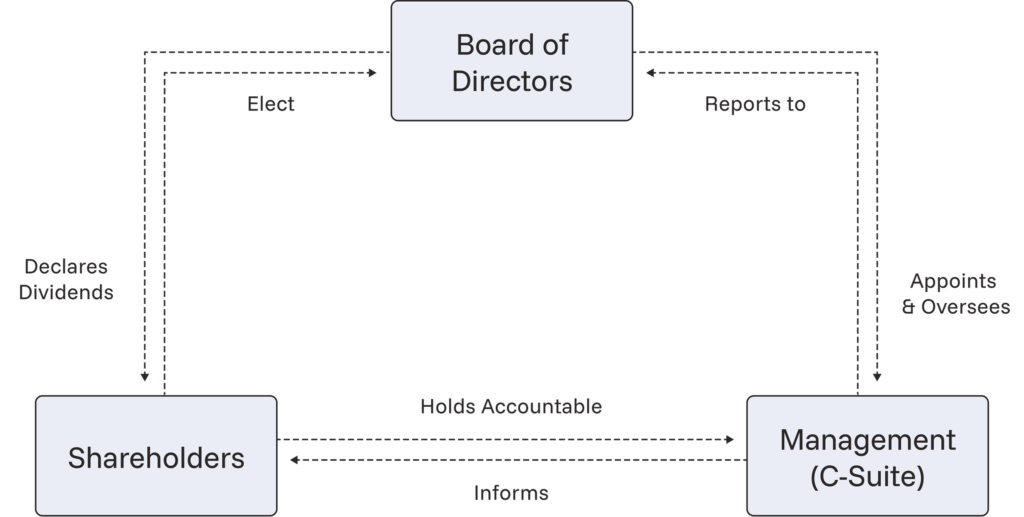
Figure 1: Traditional Corporation
Public Benefit Corporations
Public Benefit Corporations (PBCs) seek to combine the profit-making goals of conventional corporations with social goals. Over 40 U.S. states have enacted statutory frameworks to allow businesses to structure as PBCs. PBCs share the same control, ownership and limited liability as traditional corporations, but require directors to balance profit with purpose. In practice, PBC directors can, but don’t have to, prioritize the mission. Because directors have significant leeway in how they approach their mandate, PBCs are best understood as enabling rather than requiring a company to pursue social goals. In addition to the disclosure requirements of a traditional corporation, PBCs have to report how they achieve their stated public interest objectives. Delaware, currently the primary jurisdiction for corporation law in the U.S., allows PBCs to keep this report confidential.
→ OpenAI and Anthropic currently operate as PBCs.
Limited Liability Companies
Limited Liability Companies (LLCs) combine flexible management options with liability protection for their owners, called members. Managers run the AI LLCs under review, and a confidential operating agreement outlines the governance structure and the relationships between managers and members. As with corporations, LLCs are separate legal entities, such that neither managers nor members are responsible for the company’s obligations beyond their investment.
→ Google is an LLC, owned and controlled by the Alphabet Corporation.
→ OpenAI set up several LLCs during its 2019-2025 “capped-profit” phase. These LLCs primarily served two functions: they allowed the non-profit arm to maintain formal control over the for-profit arms, and they raised capital from major investors like Microsoft.
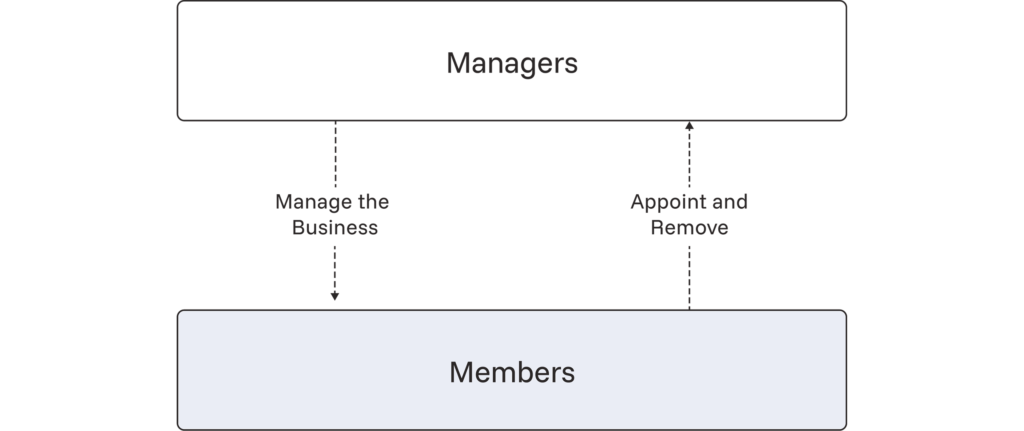
Figure 2: Limited Liability Corporation
Limited Partnerships
Limited Partnerships (LPs) enable a group of people to own a business together and share profits. There are two types of partners with distinct roles and levels of exposure to liability. General partners actively manage the business, whereas limited partners are passive investors. A confidential limited partnership agreement outlines the rights, responsibilities, and profit-sharing structure of the partnership. Unlike corporations and LLCs, LPs are not distinct legal entities. General partners bear full personal responsibility for the LP they manage, whereas limited partners typically only risk their investment. In other words, creditors can go after a general partner’s assets, but they cannot do so with limited partners.
→ OpenAI created a limited partnership to raise capital and offer equity to employees. Investors and employees were limited partners, with the non-profit entity acting as the general partner.
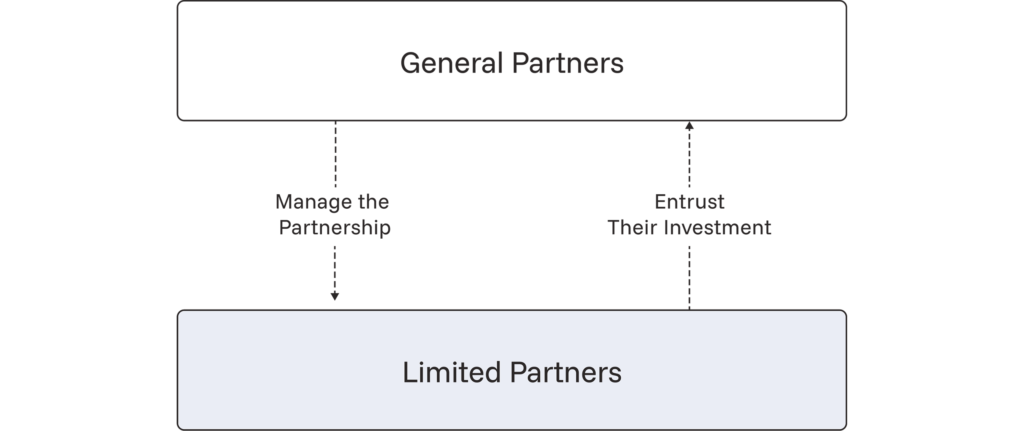
Figure 3: Limited Partnership
A for-profit corporation like Alphabet (Google’s parent company) primarily exists to maximize profit, and shareholders have various avenues to ensure directors steer the company accordingly.12These include voting out directors and actions to enforce their duties to act in the corporation and the shareholder’s interests. (<)em(>)See(<)/em(>) Practical Law Corporate & Securities, (<)em(>)Fiduciary Duties of the Board of Directors(<)/em(>) (Westlaw) (2023), (<)a href='https://law.stanford.edu/wp-content/uploads/2023/01/Fiduciary-Duties-of-the-Board-of-Directors.pdf'(>)https://law.stanford.edu/wp-content/uploads/2023/01/Fiduciary-Duties-of-the-Board-of-Directors.pdf(<)/a(>). For more on fiduciary duties, see info box below “What are fiduciary duties?”. It provides a baseline to assess whether the innovative business structures of OpenAI and Anthropic yield a better result in terms of aligning mission and action. Departing from the traditional business model, these frontier labs have crafted bespoke legal structures with a dual purpose: attract investment while pursuing their mission to benefit humanity. All three companies have evolved their structure over time, as summarized below.